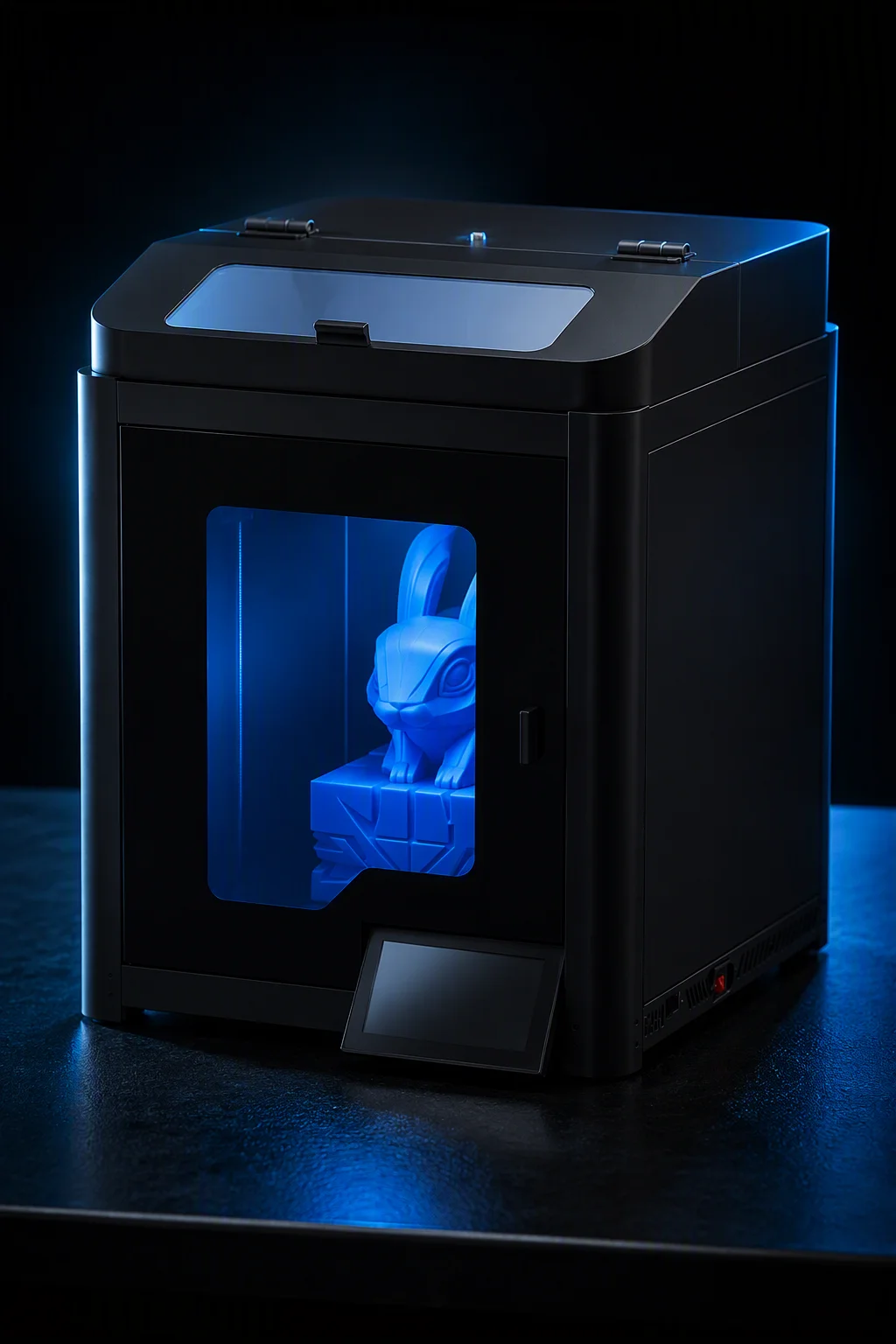
Precise3D Creator C1 — enclosed 3D printer, studio photo

Industries · Manufacturing & Prototyping

From CAD to Part
in Hours, Not Weeks

Rapid prototyping, functional testing, jigs and fixtures, and end-use production parts. Engineering-grade materials and the reliability to run 24/7 on the factory floor.

Industry Overview

Why Manufacturers Are Moving Additive In-House

For decades, the prototyping bottleneck has been one of manufacturing's most persistent pains: a design engineer completes a CAD model on Tuesday, sends it to an external service bureau, and waits until Friday -- or next Tuesday -- for a physical part. Multiply that by 5-7 iterations per project and you are looking at weeks of calendar time burned before the first functional test. In-house 3D printing collapses that cycle to hours, enabling 3-4 design iterations per day instead of one per week.

Beyond prototyping, the fastest-growing use case is production tooling. Jigs, fixtures, assembly aids, and inspection gauges that were historically CNC-machined from aluminum or steel can now be printed overnight in engineering-grade thermoplastics at 1/10th the cost. Printed fixtures and assembly aids typically take days instead of weeks to produce once the workflow is set up, which is why this use case keeps growing across workshops and factories.

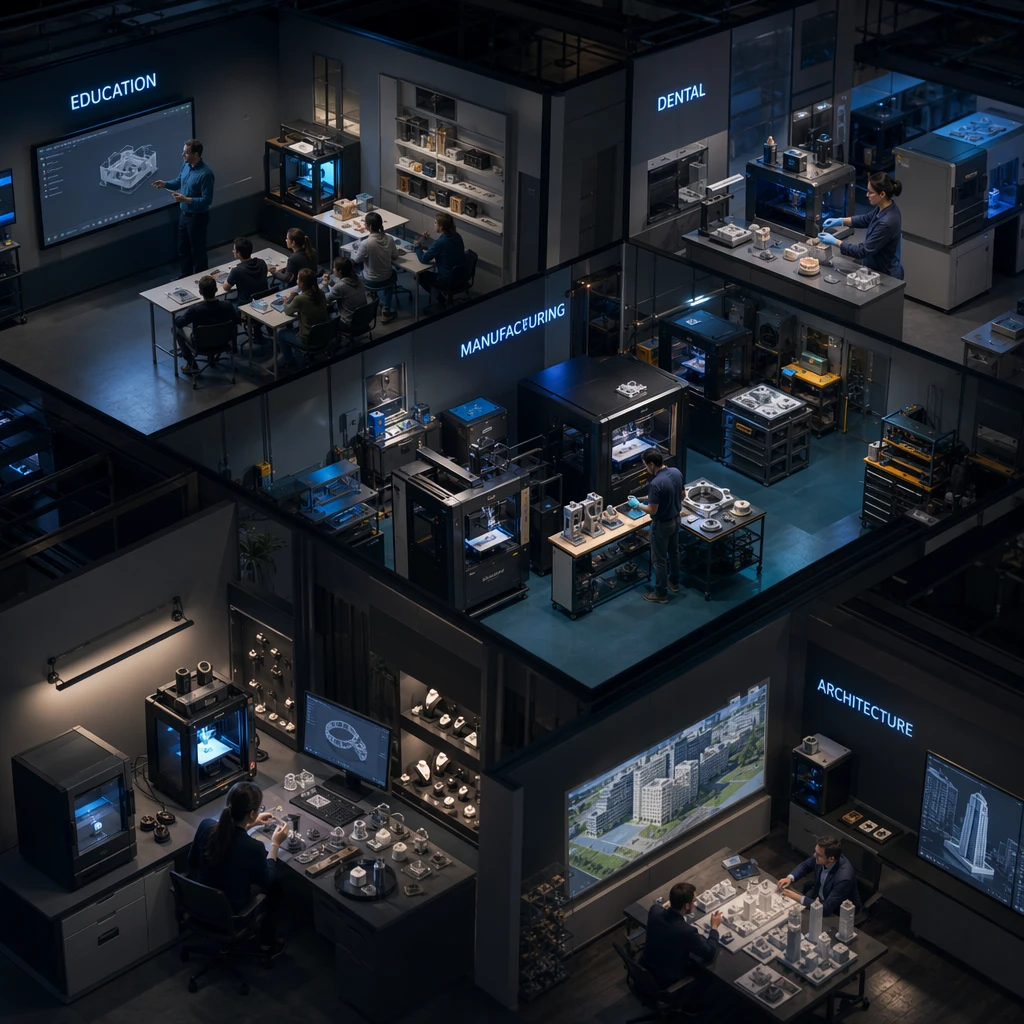
Industrial 3D printer producing a functional engineering part

Key Applications

How Factories & Engineering Teams Use Our Printers

Rapid Prototyping & Design Iteration

The classic use case -- and still the highest-volume. Print a design at 8 AM, test fit/form/function by 10 AM, tweak the CAD model, reprint by 2 PM, test again by 4 PM. Three full design cycles in a single working day versus one cycle per week with outsourced prototyping. Our Pro X1 delivers consistent dimensional accuracy, enabling engineering validation of snap-fits, clearances, and assembly interfaces before committing to injection mold tooling and its long lead time.

Jigs, Fixtures & Assembly Aids

The ROI champion of additive manufacturing. A custom drilling jig that costs $800 to CNC-machine from aluminum can be 3D printed in ABS for $12 in material and 4 hours of unattended print time. Assembly fixtures with complex contours that would require 5-axis machining are printed in a single operation. Ergonomic assembly aids -- part presentation trays, pick-and-place guides, quality inspection gauges -- are printed, tested, and modified on the same day by the production engineer who will use them, not outsourced to a tooling department with a 3-week queue.

Low-Volume Production & Bridge Manufacturing

When you need a few dozen to a few hundred units of a part but injection mold tooling is not yet justified, 3D printing fills the gap: print production-quality parts in engineering thermoplastics (Nylon, PC, ABS) while you evaluate the business case for molds. For products with genuinely low annual volumes, additive can be the permanent production method -- no tooling investment required.

Functional Testing & Validation

Print parts in the same material the production part will use -- Nylon for wear testing, ABS for impact testing, PC for thermal testing, TPU for flexibility testing. Test under real loads, real temperatures, real chemical exposure. Our validated material profiles produce parts whose mechanical properties closely approximate injection-molded equivalents, enabling meaningful functional data before committing to tooling.

Material Portfolio

Engineering-Grade Materials for the Factory Floor

Consumer PLA is not sufficient for industrial applications. Our material portfolio covers the thermoplastics that manufacturing engineers actually specify.

ABS

Impact-resistant, machinable, bondable with acetone. The go-to material for jigs and fixtures that see shop-floor abuse. Heat deflection temperature of 98°C. Available in natural, black, and gray.

Nylon (PA6)

Excellent wear resistance and low friction -- ideal for gears, bearings, bushings, and sliding components. Tensile strength of 48 MPa. Chemical resistant to oils and solvents. Requires dry storage; ships in vacuum-sealed bags with desiccant.

Polycarbonate (PC)

High-temperature performance to 110°C. Outstanding impact strength (Izod > 600 J/m). Transparent when printed thin. Used for functional prototypes that must survive thermal testing, transparent enclosures, and electrical insulators.

PETG-CF

Carbon-fiber-reinforced PETG combines ease of printing with dramatically improved stiffness (flexural modulus 3x unreinforced PETG). Low warping. Ideal for structural brackets, drone frames, and lightweight stiff components.

ASA

UV-stable outdoor-grade material. Does not yellow or embrittle under sunlight. Used for exterior automotive trim, outdoor equipment housings, and any part that lives outside. Prints similarly to ABS but without the enclosed-chamber odor.

TPU (95A)

Flexible, abrasion-resistant thermoplastic polyurethane. Shore 95A hardness. Used for gaskets, seals, vibration dampeners, protective covers, and flexible hinges. Prints on standard direct-drive extruders without modification.

Recommended Products

Industrial-Grade Printer Lineup

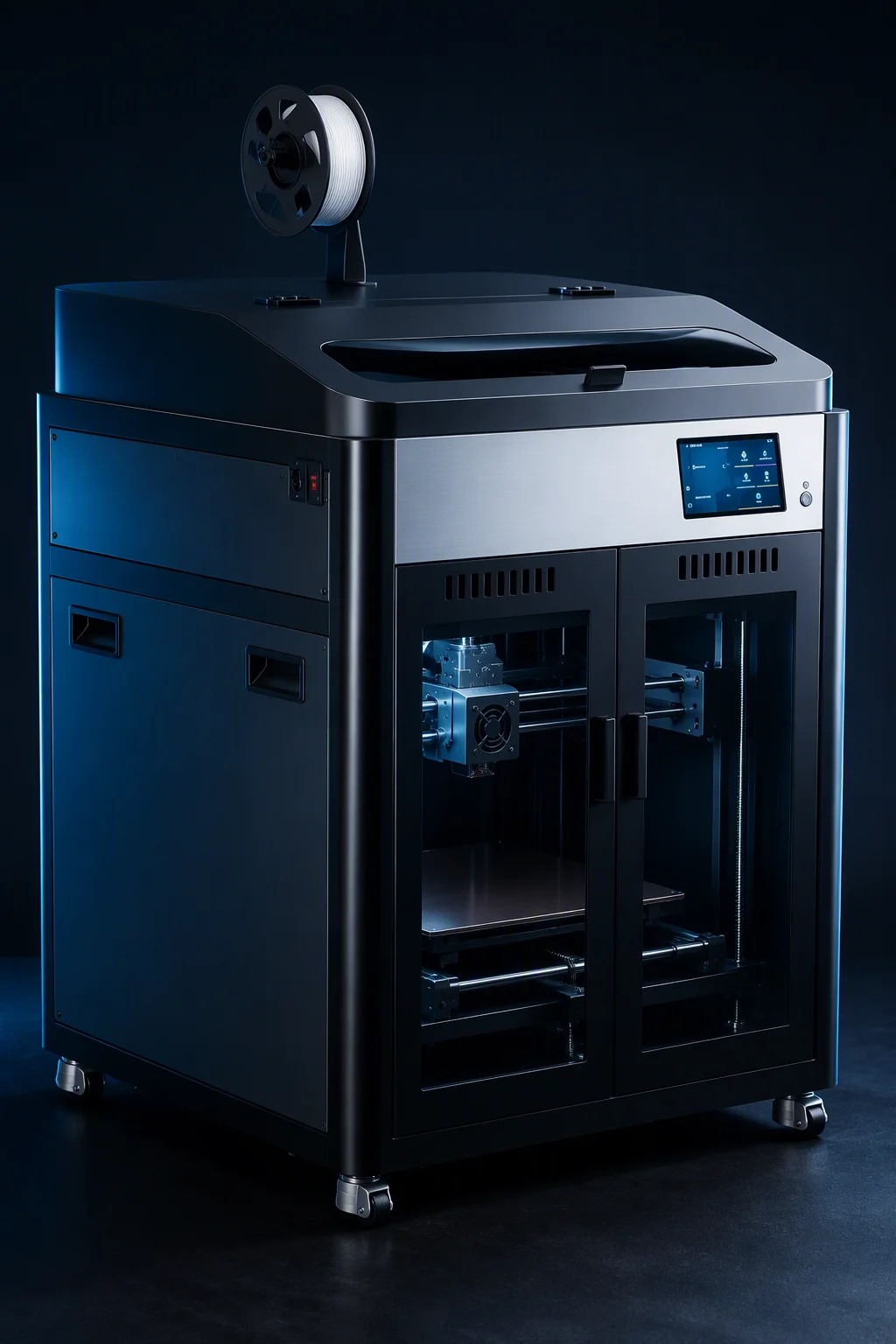
Pro X1 industrial 3D printer for manufacturing
Flagship Industrial

Pro X1 Manufacturing Edition

Built for 24/7 operation on the factory floor. CoreXY kinematics on linear rails, all-metal hotend to 320°C, fully enclosed chamber. Ships with validated profiles for ABS, Nylon, PC, ASA, PETG-CF, and TPU. The printer that replaces your outsourced prototyping queue.

  • Build Volume 500×500×500mm
  • Max Print Speed 600 mm/s
  • Max Temp 320°C nozzle / 100°C bed
  • Duty Cycle 24/7 continuous
Request Industrial Quote
Creator C1 versatile manufacturing printer
Versatile Workhorse

Creator C1 Production

The cost-effective option for smaller shops, engineering consultancies, and manufacturers adding their first in-house printer. Handles PLA through ABS and PETG. Enclosed chamber, auto bed leveling, and Wi-Fi connectivity. Ideal as a secondary/supplementary unit in multi-printer fleets or as the primary printer for firms with moderate throughput requirements.

  • Build Volume 330×330×400mm
  • Max Speed 700 mm/s
  • Nozzle Temp 320°C
  • Materials PLA, ABS, PETG, TPU
Request Production Quote

ROI Analysis

The Economics of In-House 3D Printing

For a typical manufacturer spending $3,000/month on outsourced prototyping and $1,500/month on outsourced tooling, the payback period on a Pro X1 is measured in weeks, not quarters.

Outsourced Prototyping

Where the cost case comes from — the same numbers we walk distributors through in every territory:

  • Service-bureau turnaround and feesDays to weeks, billed per part
  • Machining and tooling for one-off fixturesStarting costs before the first part
  • Rush and expedite surcharges at iteration timeLatent cost of outsourced iteration

With in-house printing, the recurring cost moves to filament and machine time — and the iteration cadence changes from weekly to daily:

  • Filament per prototypeA few dollars per design iteration
  • Print timeHours, mostly unattended
  • Operator timeMinutes to set up and start

Distributors can build the same case for their customers:

  • Prototype iteration cycleSame-day, not weekly
  • Fixture discoveryNew cost items justify the machine
  • Tooling riskValidated before the mold order
  • Payback horizonDepends on part volume — we model it together

What In-House Printing Costs

  • Filament per prototypeA few dollars, once
  • Machine timeHours, mostly unattended
  • Operator timeMinutes to set up and start
  • Power drawFraction of a workstation

The recurring cost moves from labor and expediting to filament and machine time — and the iteration cadence changes from weekly to daily. A fixture that costs a machinist quote now costs one night of unattended printing.

The Payback Math You Can Run

We do not publish a payback number that pretends to fit your shop. Instead, distributors get the same model we walk customers through:

  • Monthly outsourced spendYour current invoices
  • Quarterly tooling write-offsYour fixture and mold costs
  • Machine cost ÷ monthly saving= payback in weeks or days

Tooling risk is the part we quantify first: a fixture validated on the Pro X1 answers the question before the mold order, not after it.

Production Reliability

Engineered for Continuous Operation

Power-Loss Recovery

Factory power fluctuates. Our printers detect voltage drop and save the current layer position to EEPROM before shutdown. When power returns, the printer homes, reheats, and resumes from the exact interrupted layer. A 40-hour print that loses power at hour 34 resumes at hour 34 -- not hour 0. The electronics behind this feature are verified on the burn-in line.

Filament Run-Out Detection

Optical sensor at the extruder entrance detects filament depletion and immediately pauses the print. The printer retracts slightly, moves the toolhead to a park position, and sends a notification (on-screen, Wi-Fi, and optional email). Operator loads a new spool, confirms on the touchscreen, and the printer resumes. Designed for overnight/lights-out operation.

Pre-Shipment Burn-In

Every printer runs on our production network's dedicated burn-in testing line before packaging: a continuous print test that verifies motion, extrusion, and heating performance. Units that do not pass are reworked rather than shipped, and serial numbers tie each unit to its test record.

Industrial Partnership

Equip the Manufacturers in Your Market

Distributors: we provide technical datasheets, material certifications, sample parts, and ROI calculators to help you sell into engineering and manufacturing accounts. Our industrial support team handles pre-sales technical questions so you can focus on relationships.