
Why MTBF Alone Is a Trap
MTBF — mean time between failures — is the number a manufacturer quotes because it is kind to the hardware. It is calculated as total operating time divided by the number of failures, and a higher figure looks better on a spec sheet. But MTBF tells you nothing about the cost of a failure. A machine can fail rarely and take a week to repair, and still be a worse production asset than a machine that fails a little more often but is back to work in twenty minutes.
That is the whole point of availability. In reliability engineering, availability = MTBF ÷ (MTBF + MTTR). The number is a percentage of time the system is in a fit state. It collapses both the "how often it breaks" and the "how long it stays broken" into one number an operator can schedule against. For the service and maintenance layer behind that, the maintenance guide and the maintenance plans & extended warranty guide show how the repair time is actually won.

The Math Behind Availability
Here is the table a distributor wants to be able to pull up in a meeting. Each row turns a percentage into the annual downtime an operator will care about, because percentages are abstract but days are not.
Notice the jump from 98% to 95% is not a small change. Dropping three points moves the machine from a few days of downtime to more than two and a half weeks a year. For a distributor quoting a print farm, that is the difference between a healthy operation and one that quietly loses money.
What Actually Drives MTTR Up
Mean time to repair is not a hardware property; it is a service property. It depends on how fast you can diagnose, whether the spare part is on the shelf, and how quickly a technician can act. A printer with excellent geometry but a part that takes three weeks to source will have a poor availability number regardless of how good its MTBF is.
- Diagnosis speed — a clear fault log and a modular design cut time-to-fix dramatically, exactly the discipline in the print failure diagnosis guide.
- Spare-part availability — keeping the common wear items local is why the spare parts aftermarket guide and the warranty & returns guide matter commercially.
- Remote support — the ability to read a fault without a site visit is a direct MTTR reduction, tied to the remote monitoring & connectivity guide.
This is the reframe that wins industrial deals: selling a low MTTR is worth more than selling a high MTBF, and the buyer can see it in the math.
Component Life Is the Real MTBF Driver
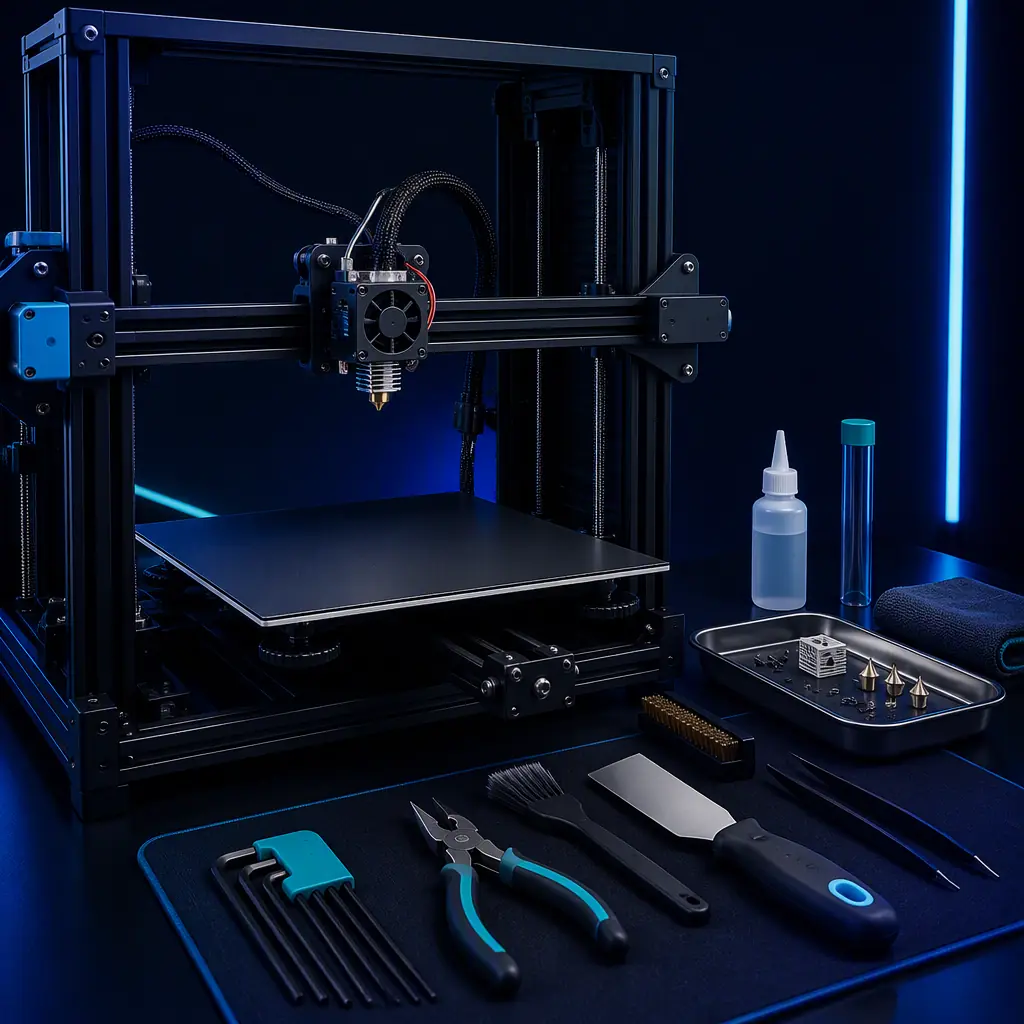
An FDM printer is a system of distinct wearing parts, and its overall MTBF is really the aggregation of the most fragile component in the chain. The extruder nozzle, the drive belt, the thermistor and the part-cooling fan are all consumables with finite life, and their life expectancy is set by duty cycle and material rather than by a single rating.
For a distributor, the lesson is that you can sell reliability by showing you plan for component life. Recommendation intervals for a nozzle swap or a belt check are a concrete, testable value. The nozzle & hotend technology guide and the part-cooling fan guide get into how those parts are chosen, and the belt tensioning guide covers the one adjustment that most affects long-run consistency.

OEE: Putting Reliability in the Whole-Picture Frame
Production managers rarely stop at availability; they think in terms of overall equipment effectiveness, which is availability multiplied by performance and by quality. Even a machine that is up all the time is not effective if it is printing slowly or producing reject parts. That entire frame is why reliability is never a single number — it is a relationship between uptime, throughput and yield.
This is the language a distributor should speak to an industrial buyer, and it is why the TCO & ROI calculator guide and the print farm economics guide frame the purchase in terms of recoverable value rather than sticker price. For the power and operating cost side of the same equation, the energy consumption guide closes out the ledger.
How to Validate a Reliability Claim
A manufacturer saying "our machine is reliable" deserves zero credit. A manufacturer saying "our hotend assembly is rated for a known operating window, we publish the MTTR assumption, and we stock the common wear parts locally" deserves a hearing. Here is the short checklist a buyer should be able to run, and a distributor should be ready to meet.
For the supplier-file side of that, the factory audit & QC checklist shows how a buyer audits the production line that builds the machine, and the safety & thermal runaway guide covers the failure mode that most often converts into a real, costly event.

The Distributor Advantage
Every distributor owns an asset that the manufacturer does not: proximity. You are the one who can turn a repair from a three-week wait into a same-day swap, and that is the single largest lever on MTTR in the whole chain. Position your reliability conversation around the service you can give, not the number on the sheet. When you do, the machine is no longer competing on price — it is competing on the production time your support provides.
What you're looking for: If the answer is "we will replace it when the part arrives" with no defined time, you are selling MTBF but not availability. The buyer does not want a spec, they want a recovery plan — define MTTR and the local stock before you quote continuous production.
How Precise3D Builds Reliability In
At Precise3D we run a 3,500 sqm Shenzhen production network with four assembly cell groups and a dedicated burn-in and aging line, and we treat reliability as an engineering requirement rather than a marketing claim. Our hotend and motion assemblies are chosen for a documented operating window, our enclosures are engineered to hold temperature under load, and our machines ship with CE LVD (EN 62368-1:2014+A11:2017) and RoHS (EU 2015/863) documentation so the compliance file matches the performance claim.
Custom branding and OEM white-label starts at 100 units, and the fastest honest validation is a one-to-five-unit sample order at wholesale pricing, tested in your own market before you commit. Our TCO & ROI guide and the maintenance plans guide sit beside the engineering file so a distributor can build a reliable story, not just a spec sheet.
Reviewed by the Precise3D OEM & distribution team. Reliability figures are load- and duty-cycle-dependent; always quote availability and service response on the basis of your specific configuration, duty cycle and local support capability rather than a single advertised number.
Source With Confidence
Looking for a Printer You Can Keep Running?
Join our network of global distributors. Reliability engineered in, common wear parts stocked, and the support model that turns a good machine into continuous production.