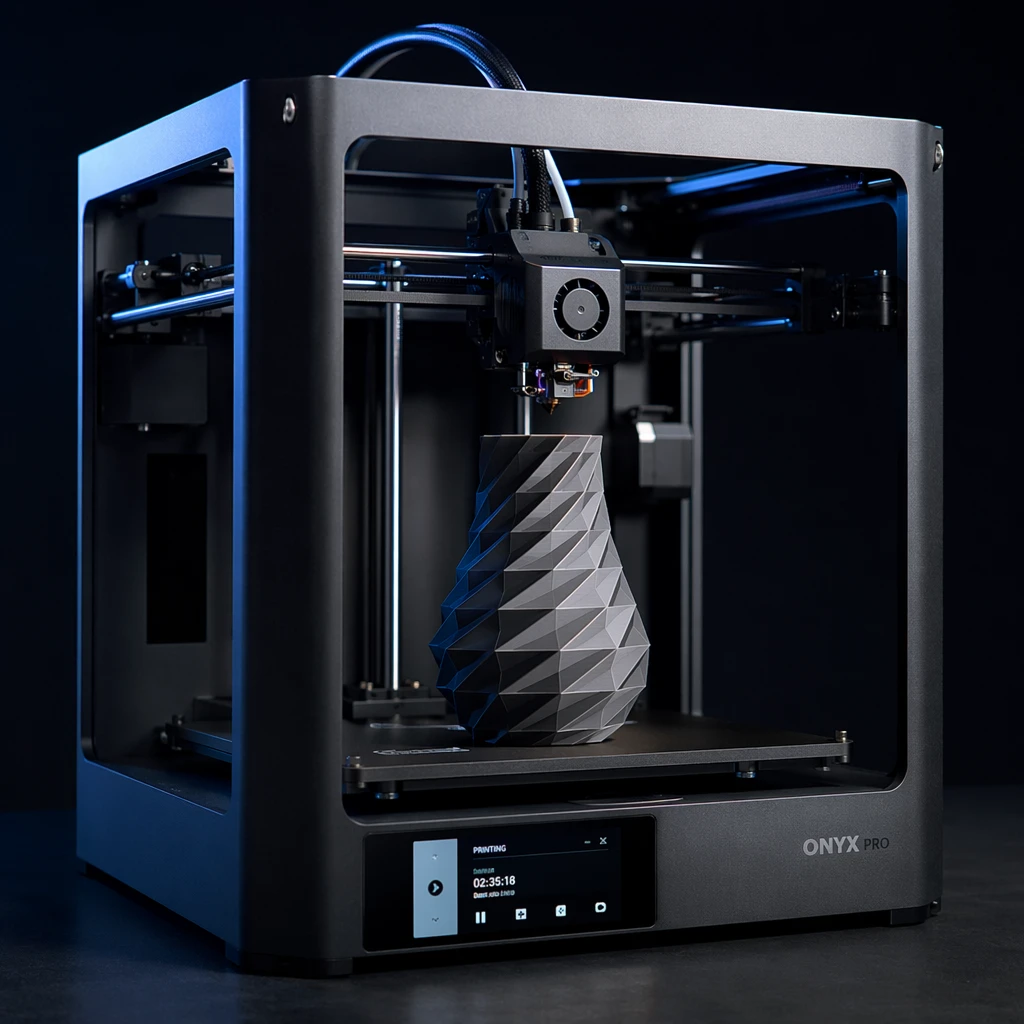
Five years ago, a consumer 3D printer running at 60mm/s was considered fast. Today, machines shipping with 500mm/s default profiles are hitting retail shelves at under $500. The physics haven't changed — but the engineering has. This shift isn't just a spec-sheet race; it's redefining which printers belong in which sales channels, what accessories distributors need to stock, and how support teams should train.
The Three Enablers
Three technologies converged to make high-speed printing practical outside industrial labs:
1. CoreXY Kinematics
Traditional Cartesian printers move the bed on the Y-axis, which means accelerating a heavy build plate (plus the printed part) back and forth. At high speeds, this introduces ringing artifacts and requires a rigid frame. CoreXY uses a belt-driven gantry where the bed only moves on Z — the toolhead does all X/Y motion with much lower moving mass. The result: less ringing, higher acceleration, and print quality that doesn't degrade at speed. Our Pro X1 uses a dual-motor CoreXY system that holds 20,000 mm/s² acceleration with layer consistency within 0.02mm.
2. High-Flow Hotends
Speed is meaningless if the hotend can't melt filament fast enough. A standard hotend melts roughly 10–15 mm³/s of PLA. At 500mm/s with a 0.4mm nozzle and 0.2mm layers, you need ~40 mm³/s. High-flow hotends increase the melt zone length and use bimetal heat breaks or ceramic heaters to sustain flow rates above 50 mm³/s. The Pro X1 ships with a 60W ceramic heater capable of 300°C at full flow — which means ABS, PETG, and even nylon at speed.
3. Input Shaping & Pressure Advance
Firmware is the silent partner. Klipper and Marlin now support input shaping — a technique borrowed from CNC machining that compensates for the printer's resonant frequencies. Combined with pressure advance (which adjusts extrusion rate during acceleration/deceleration), the printer can cancel out its own vibrations in real-time. A properly tuned Pro X1 running at 500mm/s produces surface finish comparable to a 2019-era printer at 80mm/s.
What This Means for Distributors
High-speed printing changes three things for B2B buyers:
Product tiering gets clearer. The gap between a $200 entry-level printer and a $600 mid-range model is now measured in print speed and material capability, not just build volume. Retailers can build a clear good-better-best story: the Start S1 handles the basics at 180mm/s, the Creator C1 adds silent operation and multi-material at 300mm/s, and the Pro X1 unlocks the full 500mm/s with engineering materials.
Accessories become a second revenue stream. High-speed printers consume filament faster and wear nozzles quicker. Distributors who bundle hardened steel nozzles, high-flow filament spools, and spare build plates with every printer sale see 20–30% higher average order value.
Support training shifts from "why did my print fail" to "how do I tune for speed." Input shaping calibration, pressure advance tuning, and acceleration settings are the new support questions. Precise3D provides all distributors with video training modules and pre-configured profiles for popular slicers.
Where the Market Is Heading
We expect 300mm/s to be the baseline for any "mid-range" consumer printer by Q4 2026. Entry-level machines will settle at 150–200mm/s with simplified auto-calibration. Professional desktop units will push toward 800mm/s with active chamber heating for engineering polymers. The technology curve is steep — and the distributors who stock the right mix now will own their categories by 2027.